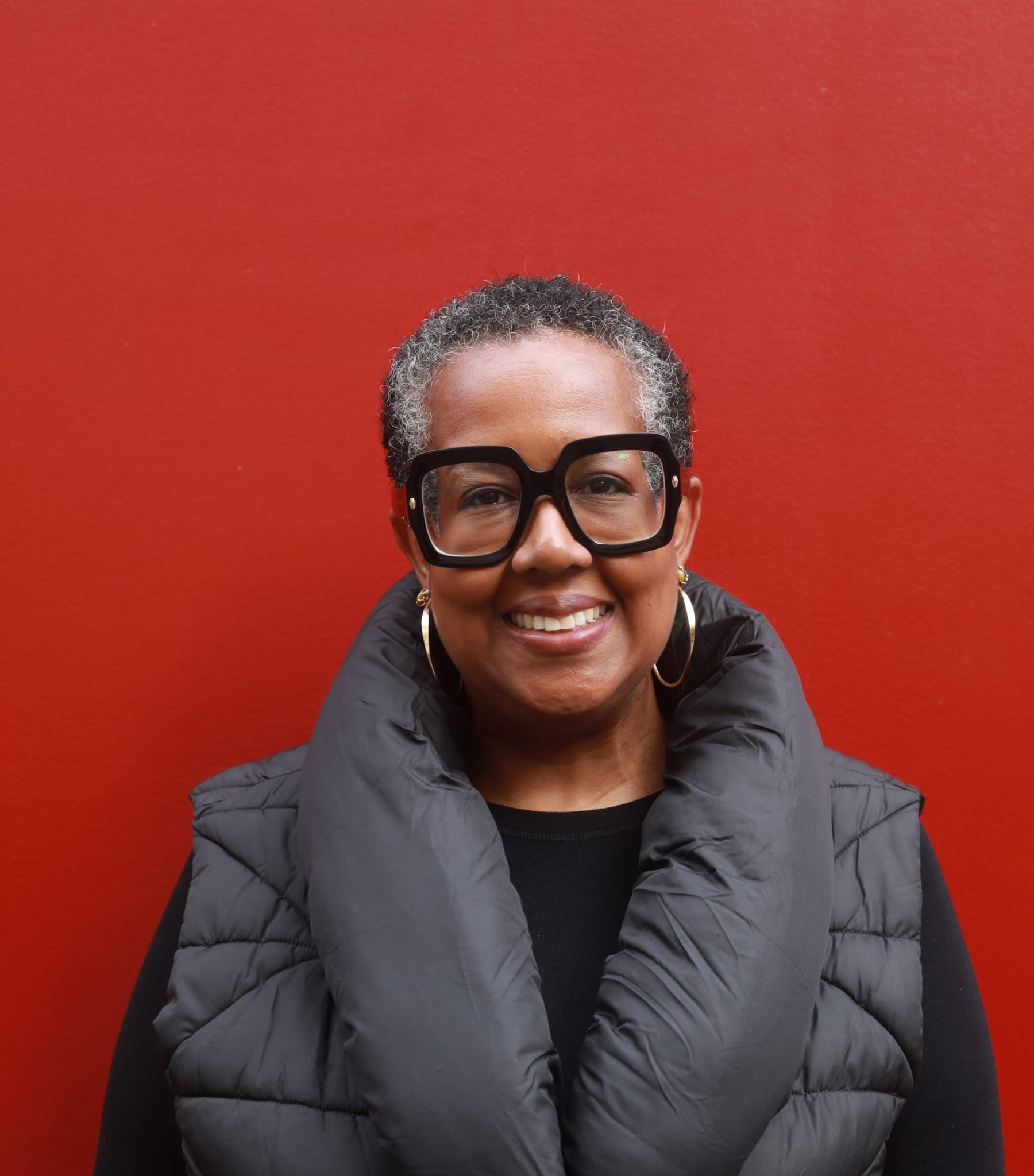
Alana Manga
Inaugural Dean of Student Success
Paris College of Art
In April 2024, WIF had the pleasure of working with the Paris College of Art (PCA) to introduce U.S. high school students from the Going Global with Barbara International Youth Leadership Program to the possibility of pursuing undergraduate education abroad.
As the college’s Director of Student Success and Registrar, Alana Manga was instrumental in organizing this life-changing visit for the program’s first all-male cohort.
For our second visit to PCA (November 2025), we are thrilled to acknowledge that Manga is working with us in a new position as Inaugural Dean of Student Success. She graciously granted us this in-depth interview to share her trajectory to this new role and what the post means to her.
WIF: You began your academic journey in the sciences before moving into education and student success leadership. What inspired that shift, and how do those early experiences continue to shape who you are today?
Dean Manga: I was always drawn to teaching, reading, and how people learn. I taught my dolls as a child, and would often share my thoughts with family, neighbors, really anyone who would stand still long enough. Little Alana knew things and was going to share them!
At the same time, I observed my parents, who were influential in their spheres, demonstrating how to educate to improve the world in their professional roles. I sought to imitate how they cultivated communities of thought and care around them. There is a ripple effect to this kind of exchange; ever enlarging and impactful, both directly and indirectly.
Pragmatically, the summer before my senior year of undergraduate study in biology, I worked on a project co-funded through the New York State Department of Labor’s Summer Youth Employment Program. My job was to tutor summer school students, developing workforce readiness lessons that aligned with curricular modules. I was HOOKED! The students were delightful, the material interesting and relevant, and it was eye-opening to me. Yes! Meaningful teaching and learning happens outside of the traditional classroom setting, too.
When I returned to my college campus after that summer, I sought out elective courses at the education department of my college. Then, after completing my undergraduate degree, I chose to begin a Master of Science in School Psychology. I wanted to investigate the praxis of small-group knowledge transmission in a non-traditional setting. Thereafter, I pursued a MA in Education and a Certificate in Educational Administration to understand the policy that undergirds the work of knowledge transmission.
Kindness, community building, non-traditional teaching and learning, and an understanding of institutional theory and practice are the gifts I have received from these experiences and carry forward.
WIF: You’ve worn many hats over your career—teacher, counselor, professor, director, and now dean. Looking back, what thread ties all these roles together for you?
Dean Manga: In each of my professional roles, building community with kindness has been an integral characteristic. You know, this is the real underpinning of the work of educators. We draw people closer to encourage thinking, listening, sharing ideas in order to change their lives and others around them. And I think kindness is inherent in this work; I mean that the act of teaching others demonstrates a belief of cultural community, continuity and hope.
WIF: Paris College of Art has been your professional home for nearly a decade. What first drew you to PCA, and what keeps you inspired to contribute to its growth?
Dean Manga: PCA is a lovely school of arts education in the 17eme arrondissement. I happened to see their search for a registrar in 2016. I thought it would be an interesting opportunity to apply my U.S.-gained experience in an international environment. I am lucky that I am able to continue the work that I love in a school that is evolving and student-centered.
The students encourage me. They are bright, curious people, most often young adults, who are at an important stage in their human development. Their passion for their artistic/design practices is phenomenal. I enjoy watching their growth and learning about the passions that capture their artistic/design imaginations.
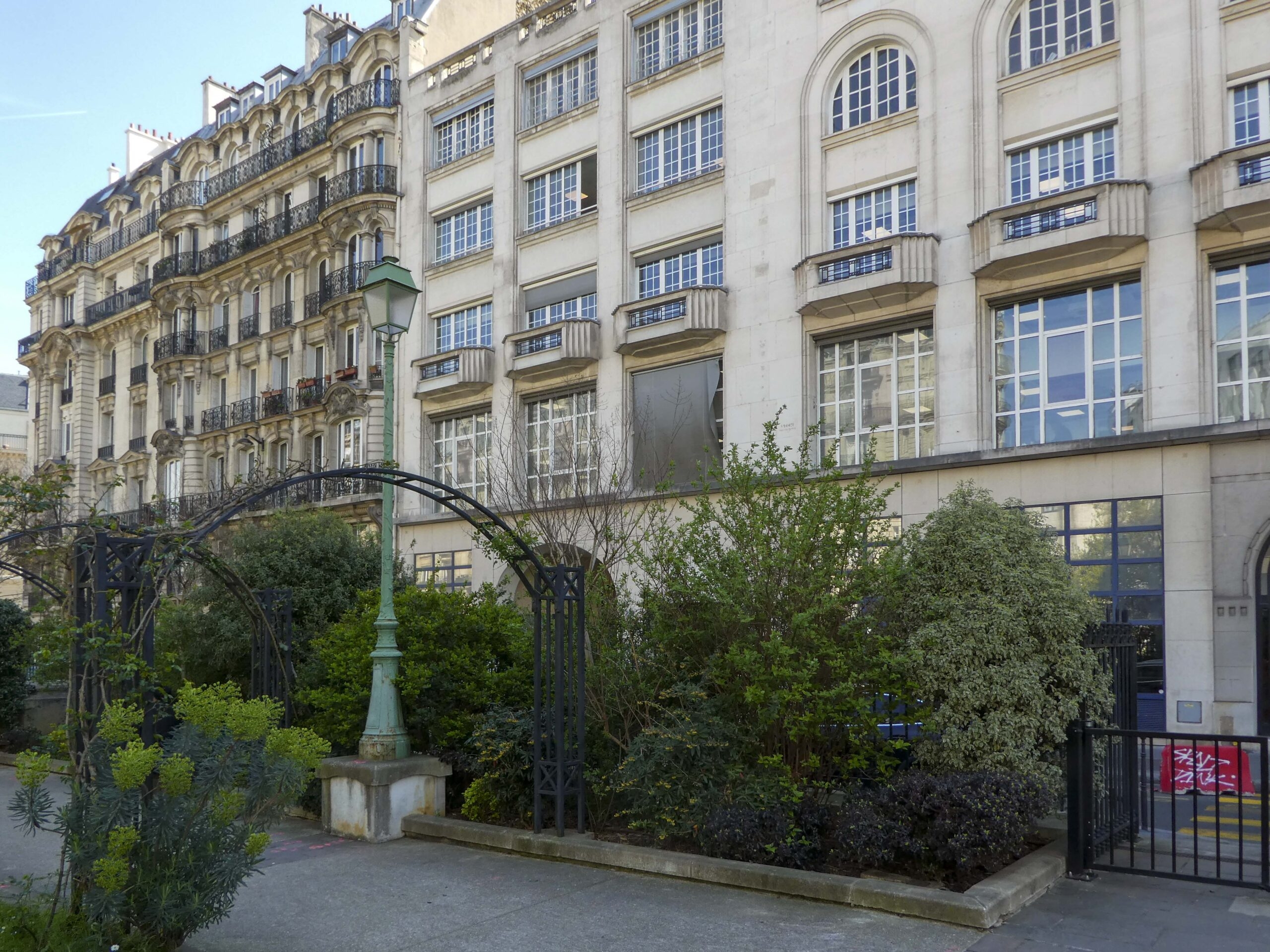
Paris College of Art viewed from
esplanade at boulevard Pereire
WIF: This new position of Dean of Student Success is a milestone for both you and PCA. How did you feel when you learned you’d be stepping into this inaugural role?
Dean Manga: I was and am still excited! This is a strategic leadership role that directly and indirectly impacts the student experience at PCA; both pastoral care and policy. I have the privilege of knowing the students individually and collaborating with other Administrators to align positive student outcomes across multiple dimensions.
There is also a very talented Student Success alliance of creative individuals with whom I have the pleasure of collaborating. They are invested in the work of developing a continuum of support and extra-classroom learning that aligns with the curricula. I am deeply impressed with their efforts and am encouraged by their capacities to lead.
WIF: You often speak about empowering students to take ownership of their journeys. Can you share a story of a student who reminded you why that kind of agency matters?
Dean Manga: I have been very lucky to be present for many illuminating moments. I think the common thread has been witnessing students’ sudden personal growth, developing situational awareness, and subsequently asking for help. There is agency in self-reflection, articulating one’s needs, and seeking assistance to fulfill them.
WIF: Moving from the U.S. to France is no small leap. How has living and working in an international academic community influenced your views on inclusion and belonging?
Dean Manga: Situating myself in an international academic environment has emphasized the importance of building community and coalitions where I am. For this reason, I think that inclusion efforts must be personalized and meaningful.
Why?
As noted by Sara Ahmed, in her book On Being Included, institutional thought on belonging is traditional, often-shallow, and slow-moving. Thus, only relevant and consistent efforts will lead to true change over time.
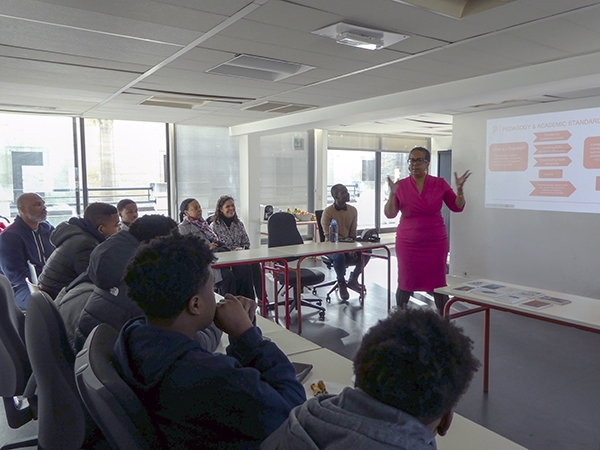
Alana Manga speaking to the April 2024 all-male cohort for the Going Global with Barbara International Youth Leadership Program
WIF: You’ve served as both an educator and an advocate. What have your students—and perhaps your colleagues—taught you about resilience and creativity in challenging times?
Dean Manga: I have profited from ties to many amazing colleagues and students, many of whom were from populations that have not been traditionally welcomed in higher education. For this reason, their very presence was revolutionary and hopeful.
I have also benefited from their gifts in demonstrating that change takes time and institutions move at a glacial pace. I have witnessed colleagues, assigned to various roles within a college, foster environments that welcome all students; serving as informal mentors. In my eyes, this is the beloved community at work, regardless of budgetary constraints, limiting policies, and traditional knowledge transmission discourse.
WIF: Leadership can be both demanding and deeply fulfilling. How do you nurture your own sense of purpose while helping students find theirs?
Dean Manga: My four children strengthen my purpose. They are the ones that give me the motivation to work with integrity and to expand my understanding of who I am and what I can do. I want to demonstrate to them that they can overcome any obstacle in their life journey. And lastly, I want them to be proud of me, as I am incredibly proud of them.
WIF: You once chaired the board of a nonprofit that fought homelessness and poverty. How did that experience shape your understanding of the broader social and emotional dimensions of student success?
Dean Manga: Student success is not limited, in my purview, to earning an “A” in a design course or writing a perfect art history essay. Student success is a holistic framework that encompasses the physical, mental, emotional and psychosocial aspects of a person. Is the student prepared to learn? Do they have a quiet place to work? Do they have all of the materials to start their work? Do they require accommodations for their assignments? These are a few of the critical factors that encourage student success.
I think the visual forwarded by psychologist A. Maslow is an ideal criterion for considering human needs. If basic physiological needs, a sense of safety, and a sense of belonging are not present, the higher-order thinking necessary for academic or creative/design practices is derailed.
WIF: The arts have a unique rhythm and energy as a discipline. What have you learned about supporting artistic students in particular—their unique needs, motivations, and spirits?
Dean Manga: What I have learned is that the students need extra-classroom speaking opportunities and different types of space. The student critiques, held at the end of each semester, are an art school rite of passage. The students are taught how to evaluate and communicate their efforts so they can present their work in front of a committee of faculty and external parties who are practicing artists/designers. The pressure on the students to understand the technical aspects of their work, analyze their artistic/design process and communicate all of this in a brief time limit is enormous!
But where can they practice this newfound skill set before the high-pressure end-of-semester critique?
Practice and preparation require community involvement. For practice sessions, students need staff, faculty, and other community members who are not in the classroom and are willing to listen to their presentation-in-process and provide feedback.
The space requirement covers several realms.
Physical space for their practice is needed, of course, but they also need a mental space where they can engage in the “what-ifs” that lead to a new insight in their work.
Another type of space (intellectual) is also necessary to explore other disciplines and domains of learning. Their work requires inspiration, references, and the guidance to situate the same.
Engraving of PCA logo
WIF: When you envision student success at PCA, what does that look like to you—not just in terms of grades or graduation, but also in the lives these students build after they leave?
Dean Manga: I hope that the students know that the community enlarges to accommodate their new identity as PCA alumni. Their connection to their university experience remains intact.
I want them to know that they can define their successes as they choose. Their ideas of what they want/who they want to be can/does evolve. Life demands change, and this is a normal aspect of their maturation as artists/designers.
And I hope they stay in touch, allowing my colleagues and me to celebrate their wins with them!
WIF: The title “Dean of Student Success” carries so much promise. What are your hopes for how this role will evolve and influence PCA’s community in the years ahead?
Dean Manga: I view my role as a liaison and catalyst, making introductions and facilitating conversations to support students through their tenure. At the same time, I have the privilege of
encouraging and supporting initiatives that work towards positive student outcomes.
I see the future Office of Student Success as an array of services, information and connections that meets the student learner where they are, at that moment. This could include “experiential” learning opportunities at any level of study, affinity services that address common complaints of life in a foreign country, and intergenerational connections in the campus neighborhood.